Data Governance
Data governance in the modern lakehouse is the framework of policies, processes, and technologies that ensures data is trustworthy, secure, and used appropriately across the enterprise.
By Alex Merced Last updated
Why Governance Matters More Than Ever
Enterprise data platforms have grown dramatically in scope, scale, and accessibility. Where data warehouses of the 1990s served a controlled population of trained analysts, modern lakehouses serve thousands of users ranging from executive dashboards to AI agents generating queries autonomously. Data from dozens of source systems flows through automated pipelines into open storage formats accessible by any engine. This democratization is powerful but introduces serious risks if left ungoverned.
Data governance is the collection of policies, processes, roles, standards, and technologies that ensure enterprise data is accurate, consistent, secure, and used in accordance with regulatory requirements and organizational intent. It is not a single tool or feature; it is a comprehensive management framework that spans people, processes, and technology across the entire data lifecycle.
The consequences of inadequate data governance are concrete and severe. Regulatory violations (GDPR, HIPAA, CCPA) result in fines and reputational damage when sensitive data is accessed by unauthorized parties or retained beyond legal limits. Inconsistent data definitions produce conflicting analytical reports that erode trust in the data platform. Untracked data lineage makes it impossible to diagnose the root cause of data quality issues or demonstrate to regulators which data was used in specific analytical processes. Poor access controls allow junior analysts to access executive compensation data or patient health records that they have no business need to view.
The Four Pillars of Data Governance
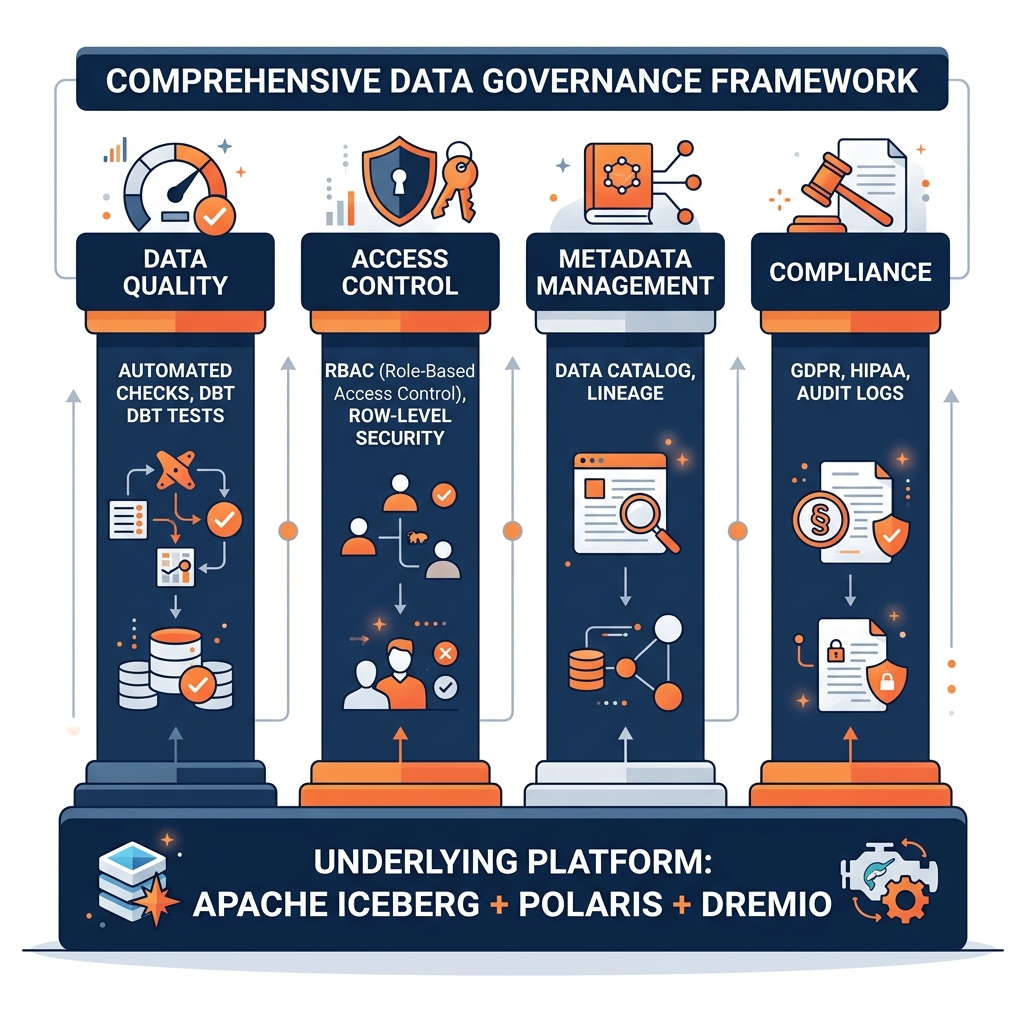
Effective data governance in a modern lakehouse environment rests on four foundational pillars that together provide comprehensive control over the enterprise data asset.
Data Quality Management
Data quality governance defines standards for data accuracy, completeness, consistency, timeliness, and uniqueness, and implements automated monitoring to detect and alert on quality violations. A data quality governance framework specifies that the customer_id column in the Silver layer Iceberg table must be non-null and unique, that all transaction_amount values must be greater than zero, and that the row count of each daily partition must fall within three standard deviations of the historical average.
These rules are implemented as automated data quality checks that run after every pipeline execution. dbt’s testing framework, Great Expectations, and Dremio’s built-in data quality monitoring all provide mechanisms for codifying and executing quality rules. When a quality check fails, automated alerts notify the data engineering team and, if the failure is severe, prevent the bad data from advancing from the Silver layer to the Gold layer where it would affect production dashboards.
Access Control and Security
Access control governance determines who can see what data under what circumstances. In a modern multi-engine lakehouse, access control must be enforced consistently across all engines that access the same underlying data, preventing the scenario where an analyst denied access to sensitive data through Dremio can simply switch to a direct Spark connection and bypass the controls.
Apache Polaris’s credential vending architecture provides one mechanism for enforcing consistent access control across engines: every engine’s storage access is mediated through Polaris, which applies RBAC rules before vending credentials. Dremio’s Row-Level Security policies restrict which rows a specific user can see within a virtual dataset, enforcing organizational data boundaries transparently for all downstream BI tools.
Metadata Management and Cataloging
Metadata governance ensures that data is discoverable, understandable, and trustworthy. A well-governed lakehouse maintains a data catalog that documents every table’s purpose, schema, data owner, update frequency, quality scores, and the lineage of how the table was produced. When a new data scientist joins the organization, they can browse the catalog to understand what data is available, who owns it, what it means, and how reliable it is, without needing to schedule meetings with the data engineering team.
Policy and Regulatory Compliance
Compliance governance implements the specific data handling requirements mandated by regulations and organizational policies. GDPR requires that personal data be deleted upon request; the governance framework must implement automated right-to-deletion processes that propagate deletion requests through all layers of the lakehouse, including Bronze raw data, Silver cleansed tables, and Gold aggregates. HIPAA requires that Protected Health Information be accessible only to authorized personnel with a clinical need; the governance framework must implement fine-grained access controls and comprehensive audit logging for all PHI access.
Governance in the Iceberg Lakehouse
Apache Iceberg and the catalog ecosystem provide the technical foundation for implementing data governance at the storage and metadata level. Iceberg’s metadata layer records the schema, partition structure, and file-level statistics for every table, providing the raw material for data cataloging and lineage tracking. Iceberg’s Time Travel capability creates an immutable audit trail of every historical data state, supporting compliance requirements that mandate demonstrating exactly what data was used in specific analytical processes.
Apache Polaris extends governance to the access control layer, implementing RBAC policies that control which principals can create, read, or modify which Iceberg tables, and enforcing those policies through its credential vending mechanism. Polaris’s audit log records every catalog access event, providing the comprehensive audit trail required by regulatory compliance frameworks.
Dremio’s Semantic Layer serves as the governance control plane for analytical access. Row-Level Security policies, Column Masking rules (which automatically obscure PII columns for users without elevated access), and access auditing are all enforced centrally within Dremio, regardless of which BI tool or SQL interface the user employs to query the data.
Learn More
If you want the long-form version, start with the books by Alex Merced. For a faster pass, there are short video explainers.