Metric Store
The metric store (or headless BI) is the architectural layer that centrally defines and computes business metrics, ensuring consistency across all downstream dashboards, AI agents, and applications.
By Alex Merced Last updated
Defining Logic Once, Using It Everywhere
A pervasive problem in enterprise analytics is the “dueling dashboards” scenario. The VP of Sales brings a Tableau dashboard to a meeting showing Q3 Revenue was $10M. The VP of Marketing brings a Looker dashboard showing Q3 Revenue was $9.5M. The meeting is derailed as the teams argue over who is right.
The discrepancy exists because business logic is fragmented. The Tableau analyst defined revenue as sum(gross_sales) - sum(returns), while the Looker analyst defined it as sum(gross_sales) - sum(returns) - sum(discounts). When metric definitions are locked inside the proprietary visualization layer of BI tools, consistency is impossible.
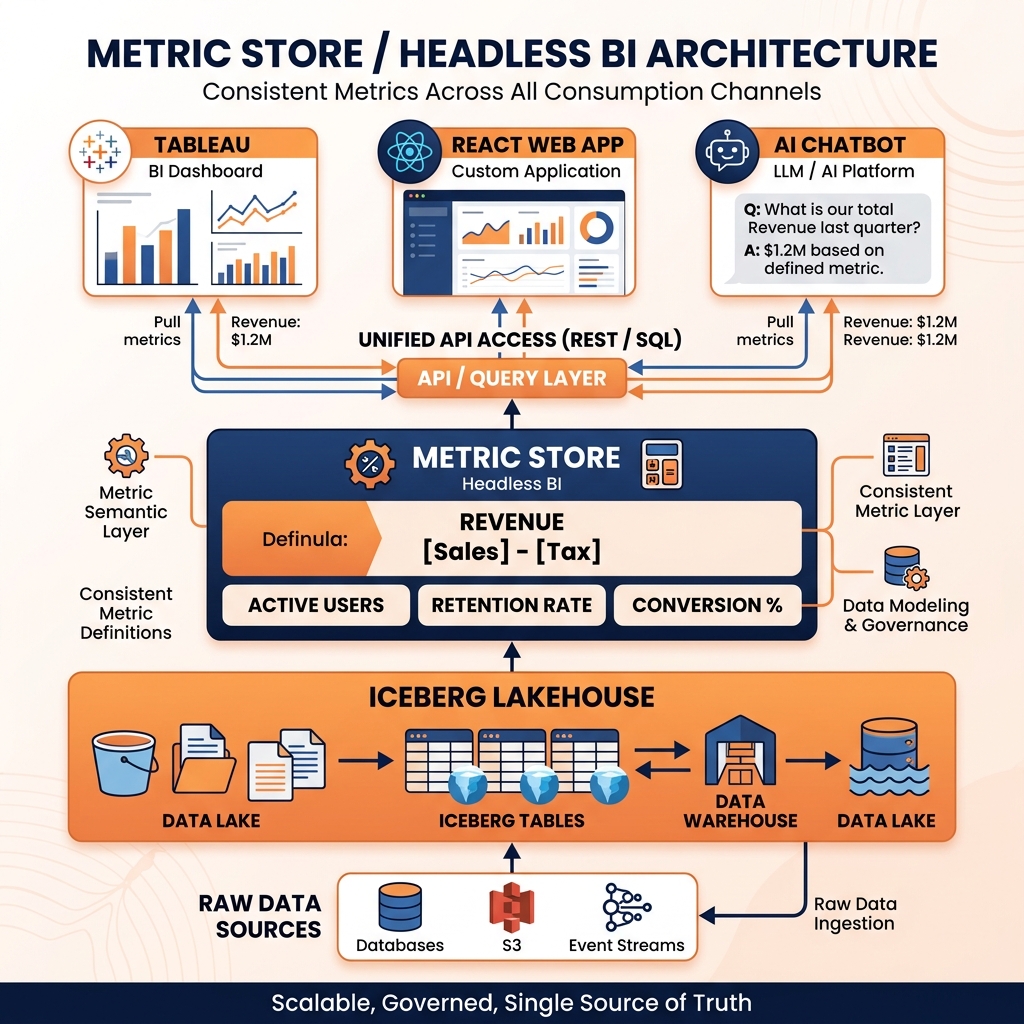
A metric store (often referred to as Headless BI) solves this by decoupling metric definitions from the BI visualization tools. It acts as a centralized repository where data teams define business metrics as code (e.g., using a framework like dbt Semantic Layer or Cube). All downstream consumers - Tableau, Power BI, custom web apps, or AI chatbots - query the metric store rather than writing their own SQL against the data warehouse.
How a Metric Store Works
A metric store relies on a semantic definition language (usually YAML). A data engineer defines the semantic model:
- Entities/Dimensions: The objects being analyzed (Customers, Products, Time).
- Measures: The base aggregations (
sum(sales_amount)). - Metrics: The business logic built on top of measures.
Revenue = sum(sales_amount) - sum(discount_amount).
When a BI tool requests “Revenue by Region for Q3,” it does not send a complex SQL query. It sends a semantic request via API or standard JDBC proxy to the Metric Store. The Metric Store dynamically compiles the correct SQL query, executes it against the underlying lakehouse (Iceberg/Dremio), and returns the consistently calculated result.
Metric Stores vs. Semantic Layers
While often used interchangeably, there is a technical distinction in modern architecture.
A traditional Semantic Layer (like Dremio’s virtual datasets) maps complex physical tables to user-friendly logical views (renaming cust_id to Customer ID, pre-defining complex joins). It provides a clean canvas, but users still write aggregations (metrics) in their BI tools against those views.
A Metric Store goes one step further: it forces the aggregation logic into the centralized layer. The BI tool cannot change the definition of “Revenue”; it can only ask the Metric Store to slice that predefined metric by different dimensions.
The AI Agent Connection
Metric stores are becoming the critical infrastructure for GenAI applications in the enterprise. LLMs are notoriously bad at writing complex, accurate SQL joins against raw data to calculate business metrics.
By placing a Metric Store between the LLM and the lakehouse, the LLM only needs to generate an API request: get_metric(metric="revenue", dimension="region", timeframe="Q3"). The Metric Store guarantees the mathematical accuracy of the result, allowing the LLM to focus on what it does best: parsing the user’s natural language intent and explaining the final numbers.
Learn More
The books by Alex Merced go further on this topic and the systems it sits inside. Short video explainers cover the same ground in under a minute each.