Hardware Acceleration
Hardware acceleration in data engineering is the use of specialized silicon like GPUs, FPGAs, and ASICs to execute massive data processing workloads exponentially faster than traditional CPUs.
By Alex Merced Last updated
Beyond the CPU
Since the invention of the database, data processing has relied almost exclusively on the Central Processing Unit (CPU). While modern CPUs are incredibly fast and versatile, they are designed as general-purpose processors-they are equally good at running an operating system, handling a web request, and summing a column of numbers.
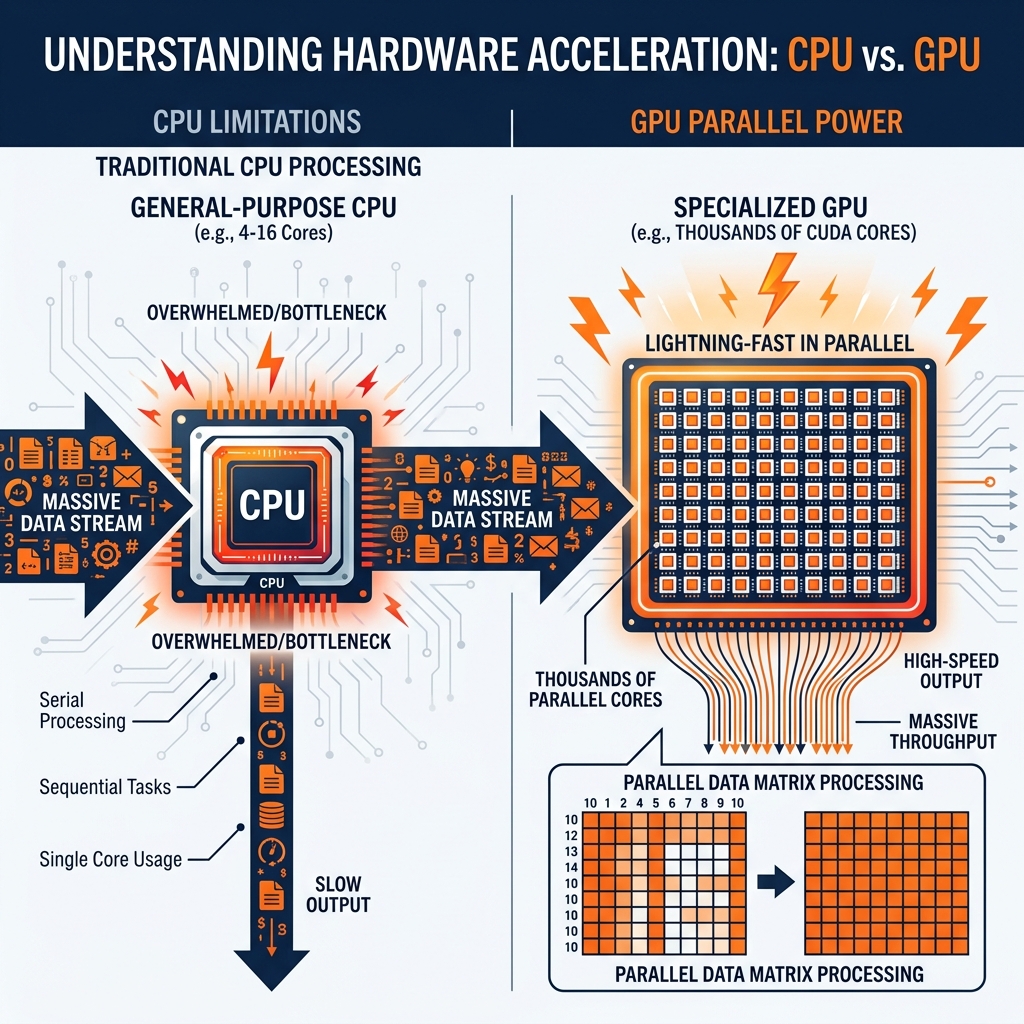
When a data lakehouse needs to perform a complex matrix multiplication across 10 billion rows to train a machine learning model, a general-purpose CPU becomes a massive bottleneck.
Hardware acceleration involves offloading these specific, mathematically intense data processing tasks from the CPU to specialized silicon designed to do one specific thing with devastating efficiency.
Types of Hardware Accelerators
1. GPUs (Graphics Processing Units): Originally designed to render millions of pixels simultaneously for video games, GPUs are the undisputed kings of parallel processing. While a top-tier server CPU might have 64 cores, a modern NVIDIA GPU has thousands of smaller cores. For data engineering tasks that involve applying the exact same mathematical transformation to millions of rows simultaneously (like deep learning model training or massive vector embeddings), GPUs can process the data 10x to 100x faster than CPUs.
2. FPGAs (Field-Programmable Gate Arrays): An FPGA is a blank piece of silicon that a data engineer can literally program at the hardware level. Instead of writing software that runs on a chip, you write code that physical alters the wiring of the chip to become a custom circuit perfectly optimized for a specific algorithm (like ultra-fast data compression or financial algorithmic trading). They are faster than CPUs but incredibly difficult to program.
3. ASICs (Application-Specific Integrated Circuits): The extreme end of acceleration. An ASIC is a chip permanently manufactured in a factory to do exactly one algorithm. Google’s TPU (Tensor Processing Unit) is an ASIC designed purely for machine learning math. It is useless for running a web server, but it trains AI models faster and cheaper than any other hardware on earth.
Hardware Acceleration in the Lakehouse
Historically, hardware acceleration was isolated to the Data Science team. The Data Engineering team would use CPUs (Spark or Dremio) to clean the data, and then hand it off to the Data Science team who used GPUs to train the models.
This is rapidly changing. Modern analytical engines are beginning to incorporate GPU acceleration directly into the SQL layer. Projects like RAPIDS (by NVIDIA) allow Apache Spark to execute standard SQL JOIN and GROUP BY operations directly on the GPU memory, bringing hardware-accelerated speeds to traditional Business Intelligence dashboards and massive ETL pipelines without requiring analysts to write complex GPU code.
Learn More
If you want the long-form version, start with the books by Alex Merced. For a faster pass, there are short video explainers.