Apache Arrow
Apache Arrow is the open-source cross-language columnar memory format that enables high-performance in-memory analytics and zero-copy data exchange between data systems.
By Alex Merced Last updated
In-Memory Analytics Before Arrow
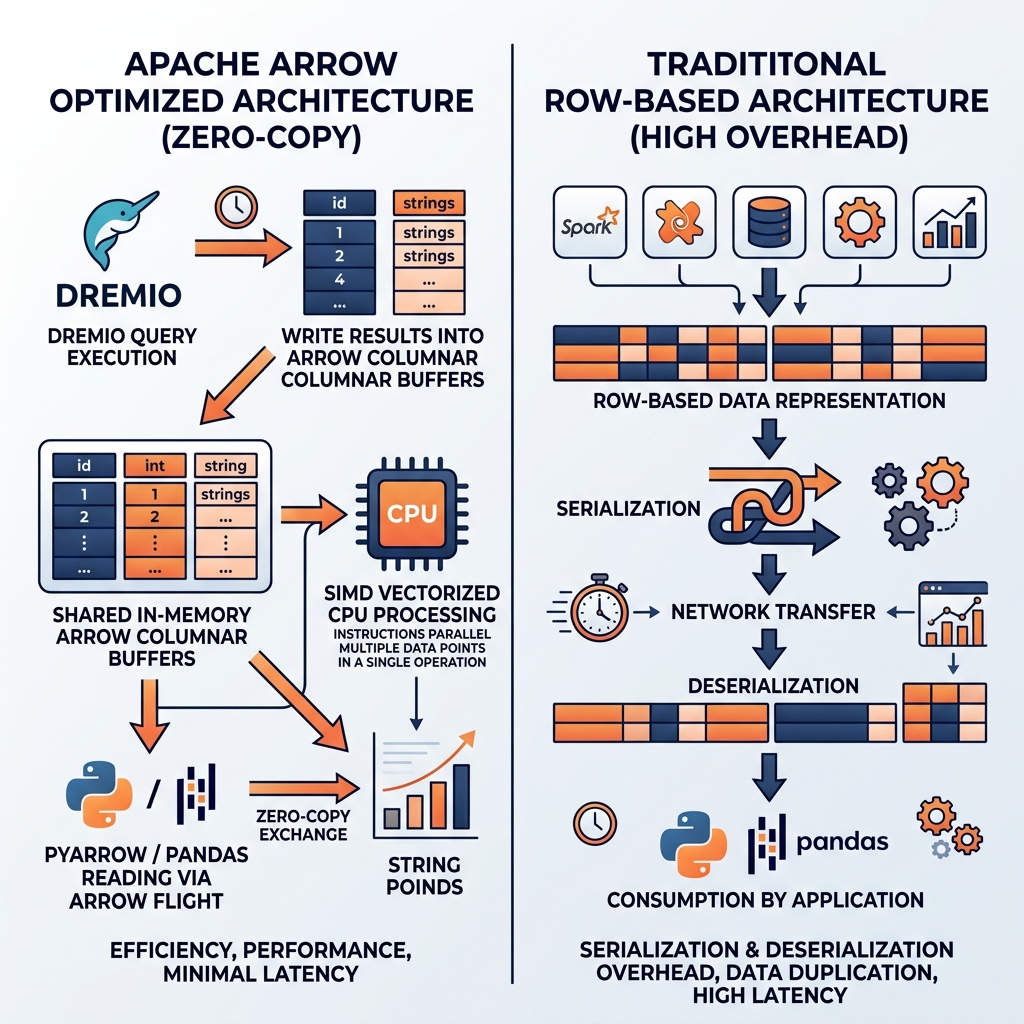
Before Apache Arrow, moving data between analytical systems required expensive serialization and deserialization cycles. A query result produced by a database as rows of data had to be serialized into a wire format (CSV, JSON, or a binary protocol), transmitted across a network, deserialized into another in-memory representation on the receiving end, and then processed. Each serialization and deserialization step consumed CPU cycles, produced memory copies, and introduced latency.
Within a single analytical process, data from different sources had to be converted into process-specific internal representations that were incompatible with each other. A pandas DataFrame used a different memory layout than a Spark RDD, which used a different layout than a database cursor result set. Data flowing between these representations required multiple conversion passes that consumed both CPU and memory bandwidth.
Apache Arrow was created to eliminate these conversion overheads through a standardized, language-agnostic, in-memory columnar format that every system can use natively without conversion. When two systems both use Arrow as their internal memory format, data can be exchanged through direct memory pointer sharing (zero-copy transfer) rather than serialization/deserialization. The receiving system accesses the same memory region the sending system wrote to, without any data copying.
The Arrow Columnar Memory Format
Arrow defines a precise specification for how tabular data is laid out in memory. Data is organized in columnar format (all values for one column stored contiguously in memory), aligned to 64-byte boundaries for SIMD vectorized processing efficiency, and uses a consistent null-handling mechanism (null bitmaps) and a uniform representation for fixed-width types (integers, floats), variable-width types (strings, binary), and complex nested types (structs, lists, maps).
This precise specification is what enables cross-system zero-copy sharing. Because every Arrow implementation in every language (C++, Java, Python, R, Rust, Go, JavaScript) uses the identical memory layout, a C++ system can write data into Arrow format and a Python system can read it directly from the same memory pointer, with no conversion. This is the foundational mechanism that makes Apache Arrow transformative for analytical performance.
The columnar layout enables CPU-level performance optimizations. Modern CPUs process data most efficiently when operating on arrays of homogeneous values (all integers, all floats) stored contiguously in cache-friendly memory layouts. Arrow’s columnar format aligns exactly with these CPU cache patterns. SIMD (Single Instruction, Multiple Data) CPU instructions can process 256 or 512 bits of Arrow column data in a single clock cycle, applying predicates, aggregations, and arithmetic operations to multiple values simultaneously.
Arrow Flight: High-Performance Data Transport
Arrow Flight is a high-performance RPC (Remote Procedure Call) framework built on top of Apache Arrow and gRPC that enables efficient streaming data transport between systems using the Arrow columnar format. Where traditional data APIs serialize data into row-oriented formats for network transmission, Arrow Flight streams data in Arrow columnar batches, preserving the columnar layout across the network boundary.
The performance implications are significant. An Arrow Flight server can stream data to a client at network-saturating speeds with minimal CPU overhead because no serialization conversion is required. The Arrow-format data batches written to the network are directly usable by the receiving client’s Arrow-capable query engine without deserialization.
Dremio uses Arrow Flight as the primary data transfer protocol for its client connections. When a Python client (using PyArrow), a BI tool, or another query engine connects to Dremio and executes a query, results are streamed back through Arrow Flight in Arrow columnar format. A Python data scientist receiving Dremio query results through Arrow Flight gets an Arrow Table object that can be directly converted to a pandas DataFrame or a Polars DataFrame with zero data copying, representing a dramatic reduction in query-to-analysis latency compared to traditional JDBC/ODBC connections that transmit data as CSV or binary row formats.
Arrow and Parquet: The Performance Foundation
Apache Arrow and Apache Parquet are complementary technologies that together form the performance foundation of the modern data lakehouse. Parquet is the on-disk columnar storage format; Arrow is the in-memory columnar processing format. Data flows from disk to memory through a Parquet-to-Arrow decoding process that is highly optimized to exploit the structural similarities between the two columnar formats.
When Dremio reads a Parquet file from an Iceberg table, it decodes the Parquet columnar data directly into Arrow columnar memory buffers. Because both formats are columnar and use similar encoding strategies, this decoding process is extremely efficient, with the decoded Arrow buffers immediately ready for vectorized query processing without any intermediate reformatting. This Parquet-to-Arrow pipeline is the critical performance path that enables Dremio and other Arrow-native engines to deliver interactive query performance on petabyte-scale lakehouses.
Learn More
For a longer treatment of this and the architecture around it, see the books by Alex Merced. You can also browse the rest of the knowledge base.