Result Set Caching
Result set caching is the specific optimization layer that intercepts exact-match SQL queries and returns pre-computed final outputs instantly, bypassing all underlying compute and network traversal.
By Alex Merced Last updated
The Ultimate Shortcut
When discussing performance optimization in data engineering, “caching” is a heavily overloaded term. It can refer to caching metadata, caching raw data blocks on local disk, or caching intermediate query fragments.
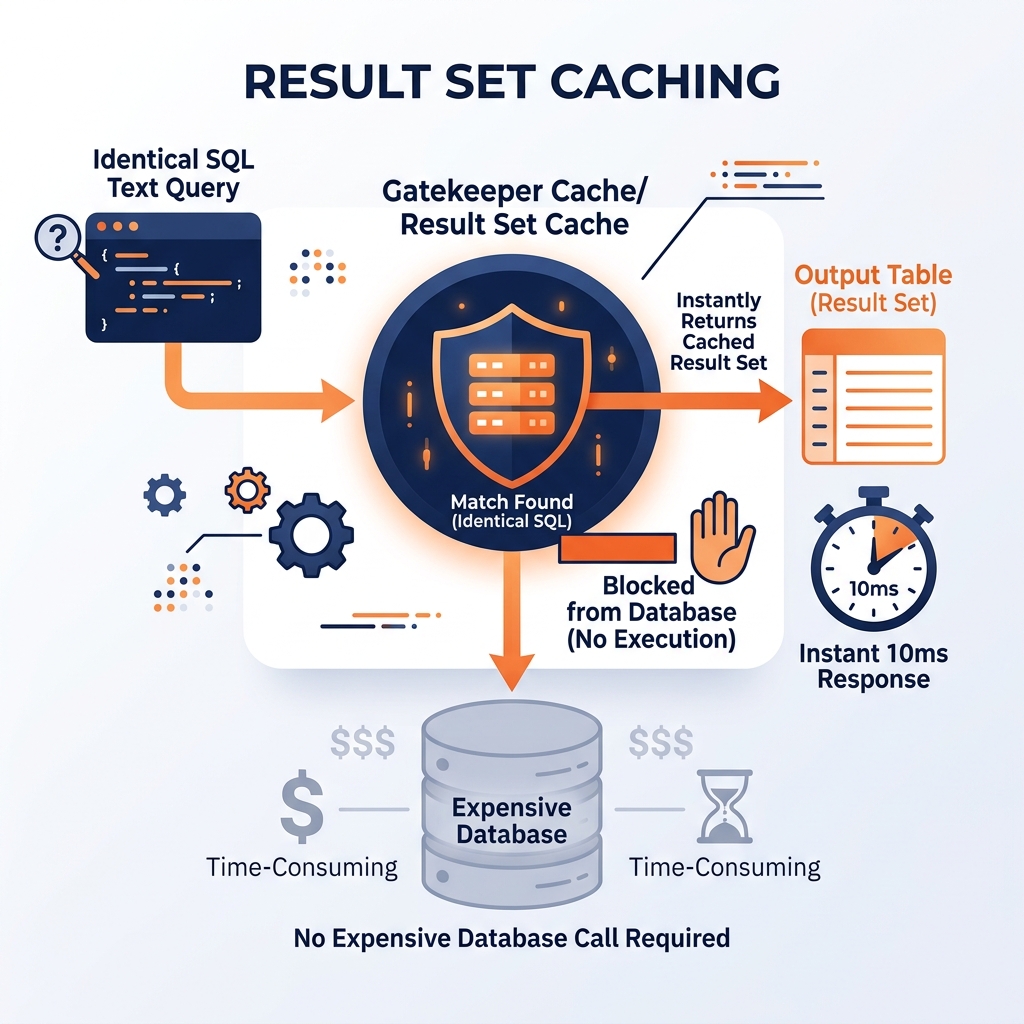
Result Set Caching is the most specific, highest-level form of caching. It operates at the very edge of the query engine, acting as a gatekeeper between the user’s Business Intelligence (BI) tool and the analytical database’s execution planner.
When a query arrives, the Result Set Cache intercepts it and checks: “Have I seen this exact SQL string recently, and is the underlying data still identical?” If the answer is yes, the cache returns the final output matrix (the “result set”) instantly. The query planner, the distributed compute workers, and the storage layer are never engaged. A query that would normally take 30 seconds and cost $5 in cloud compute executes in 10 milliseconds and costs nothing.
The Anatomy of a Cache Hit
For a query to trigger a “Cache Hit” against a Result Set Cache, several strict conditions must be met:
1. Exact Textual Match: In many implementations, the SQL string must be perfectly identical. If User A runs SELECT region, sum(sales) FROM data GROUP BY region and User B adds an extra space or changes the capitalization (SELECT region, SUM(sales) FROM data GROUP BY region), naive cache engines will treat them as two different queries and miss the cache. Advanced engines use semantic hashing to recognize logically identical queries.
2. Determinism: The query must not contain non-deterministic functions like CURRENT_TIMESTAMP(), RAND(), or NOW(). Because the output of these functions changes every millisecond, the result set can never be safely cached.
3. Identical User Context: If the underlying table utilizes Row-Level Security (RLS), User A (East Coast Manager) and User B (West Coast Manager) running the exact same SQL will return different results. The Result Set Cache must factor the user’s identity and permissions into the cache key, ensuring User B doesn’t accidentally see User A’s cached data.
Result Set Caching vs. Materialized Views
It is important to distinguish Result Set Caching from Materialized Views (or Dremio Data Reflections).
A Result Set Cache is strictly reactive and exact-match. It only populates after a user has run a query, and it only helps the next user who runs that exact same query. If someone changes a filter from year = 2023 to year = 2024, the cache is useless.
A Materialized View or Data Reflection is proactive and flexible. It is a physical table pre-computed by a data engineer containing aggregated data (e.g., total sales by region and year). It helps any query that can logically utilize that pre-aggregated data, even if the exact SQL strings differ wildly. Result Set Caching is best for highly repetitive dashboard loads, while Materialized Views are necessary for fast ad-hoc exploration.
Learn More
Several of the books by Alex Merced cover this in depth, and a few of them are free. The rest of the knowledge base is worth a look too.