Data Integration
Data integration is the technical and business process of combining data from disparate sources into unified, consistent datasets that provide a complete view of the organization's operations for analytics and reporting.
By Alex Merced Last updated
Bringing the Pieces Together
Modern businesses run on dozens of specialized applications: Stripe for payments, Salesforce for CRM, Shopify for e-commerce, Zendesk for support, and Google Analytics for web traffic. Each application contains a crucial piece of the business puzzle, but analyzing the data in isolation limits its value. To understand the true Customer Acquisition Cost (CAC), an organization must combine marketing spend data (from Google Ads) with sales revenue (from Stripe). To predict churn, support ticket history (from Zendesk) must be combined with product usage behavior (from Mixpanel).
Data integration is the process of combining this data from disparate sources into unified, consistent, and reliable datasets. It is the core engineering challenge of building a modern analytical data platform. Without data integration, organizations suffer from data silos; with data integration, organizations achieve a holistic 360-degree view of their operations.
Methods of Data Integration
Historically, data integration was synonymous with ETL (Extract, Transform, Load): extracting data from sources, transforming it into a strict unified schema in an intermediate server, and loading it into a data warehouse. This approach was rigid, brittle, and scaled poorly as data volumes grew.
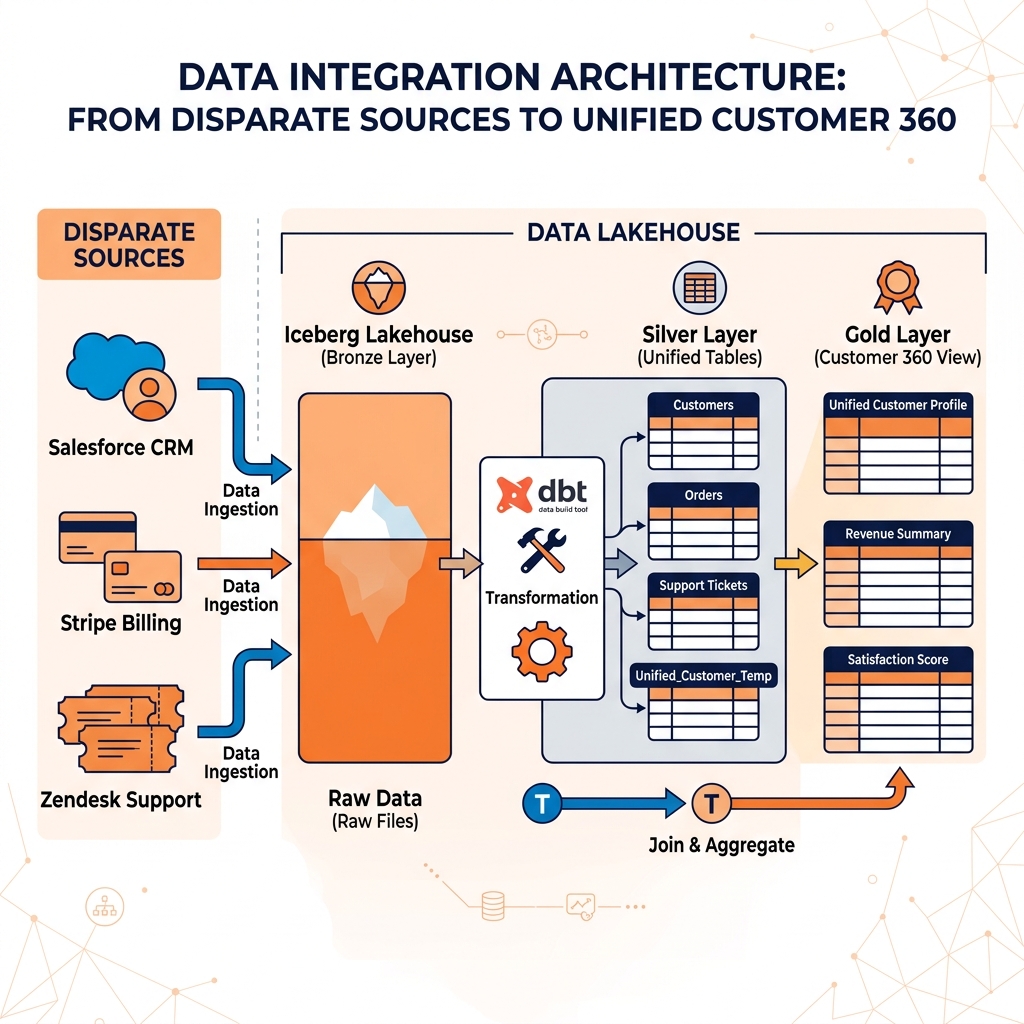
The modern data stack shifted to ELT (Extract, Load, Transform): raw data is extracted from sources and loaded directly into the data lakehouse in its original structure. The transformation (joining, cleaning, structuring) happens entirely within the lakehouse using SQL (via tools like dbt) using the massive scalable compute of engines like Spark, Trino, or Dremio.
More recently, Data Virtualization (federated queries) provides an alternative integration pattern where data is not moved at all; instead, a query engine connects to the disparate source systems and joins the data in memory at query time.
Challenges of Data Integration
Data integration is rarely as simple as a SQL JOIN command. It involves overcoming several complex challenges:
Schema Mismatches: The CRM system records a customer name as First_Name and Last_Name, while the billing system records it as a single FullName string. Integration requires mapping and transforming these schemas to a common standard.
Data Type Inconsistencies: The marketing platform stores dates as Unix timestamps, while the ERP system stores them as YYYY-MM-DD strings. Integration requires casting and standardizing data types so they can be compared and aggregated.
Entity Resolution: A customer might use john.doe@gmail.com in the support portal but jdoe@company.com in the billing system. Identifying that these records represent the same real-world entity (Master Data Management) is the hardest problem in data integration.
Latency and Freshness: Different systems export data at different rates. Combining a daily batch export of sales data with a real-time stream of web clicks requires careful handling of temporal alignment (joining events that happened at the same time, even if they arrived in the lakehouse hours apart).
Data Integration in the Lakehouse
The Iceberg lakehouse simplifies data integration by providing a flexible, central landing zone (the Bronze layer) where all data types (JSON, CSV, Parquet, Avro) from all sources can be stored cheaply. Data engineers then build declarative SQL pipelines (using dbt) to incrementally clean and join the data, moving it through Silver and Gold layers until it is fully integrated into a unified enterprise data model ready for business consumption.
Learn More
The books by Alex Merced go further on this topic and the systems it sits inside. Short video explainers cover the same ground in under a minute each.