API Gateway
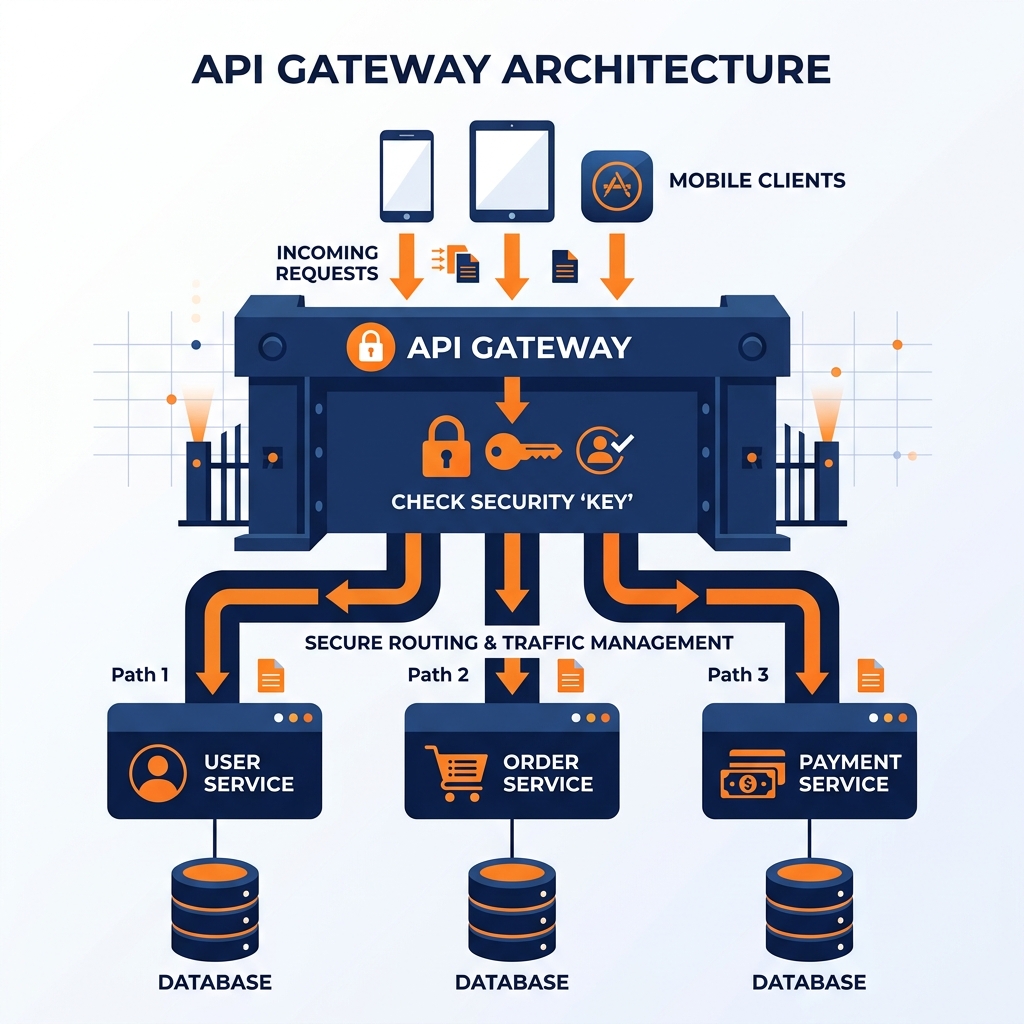
An API gateway is the architectural component that acts as the single entry point and traffic cop for thousands of microservices, handling routing, security, rate limiting, and analytics.
By Alex Merced Last updated
The Front Door to the Backend
In a modern, decentralized architecture, a single web application or data platform might rely on dozens or even hundreds of independent microservices.
If a user opens a mobile banking app, the app needs to talk to the User Authentication Service, the Account Balance Service, and the Transaction History Service. If the mobile app had to hardcode the individual IP addresses and security protocols for all three of these independent backend servers, the app would be incredibly brittle and impossible to maintain.
An API Gateway solves this by acting as the single, unified front door for the entire backend ecosystem. The mobile app only ever talks to one address: the API Gateway. The Gateway receives the request, examines it, and intelligently routes it to the correct microservice hidden deep within the private network.
Core Responsibilities of an API Gateway
1. Routing and Composition:
The Gateway acts as a reverse proxy. It takes a request to api.bank.com/balance, looks up its routing table, and forwards the request to internal server 10.0.0.5. Furthermore, it can perform “API Composition.” A single request from the mobile app might trigger the Gateway to fetch data from three different microservices simultaneously, bundle the results into a single JSON response, and send it back to the phone, drastically reducing network latency.
2. Security and Authentication: Instead of forcing every single microservice to independently verify the user’s JWT (JSON Web Token) or API Key, the Gateway handles authentication centrally. If a hacker sends a malicious request, the Gateway blocks it at the perimeter before it ever touches the internal network.
3. Rate Limiting and Throttling: To protect backend databases from being overwhelmed by traffic spikes (or malicious DDoS attacks), the Gateway enforces strict quotas. It might dictate: “A free-tier user can only make 100 requests per minute.” If they exceed that limit, the Gateway returns an HTTP 429 (Too Many Requests) error, protecting the downstream microservices.
API Gateways in Data Engineering
While traditionally used in software engineering, API Gateways (like Kong, Apigee, or Amazon API Gateway) are becoming vital in modern Data Engineering, specifically for “Data as a Service” (DaaS).
When a data team builds a highly valuable machine learning model or a real-time analytics aggregation, they don’t want to give external partners direct SQL access to the Snowflake or Dremio data warehouse. Instead, they expose the data via REST APIs, placing an API Gateway in front of it to strictly monetize, monitor, and rate-limit the partners querying the data.
Learn More
The books by Alex Merced go further on this topic and the systems it sits inside. Short video explainers cover the same ground in under a minute each.