FinOps
FinOps (Cloud Financial Management) is the evolving cultural practice and engineering discipline that brings financial accountability to the highly variable, consumption-based spend of cloud computing and data architecture.
By Alex Merced Last updated
Engineering for the Bottom Line
In the era of on-premises data centers, financial management was simple. The CIO approved a $5 million capital expenditure (CapEx) to buy a massive server rack. The servers were installed, and the cost was fixed. It didn’t matter if the data engineering team ran one query a day or ten thousand queries a day; the company had already paid for the hardware.
Cloud computing completely shattered this model. The cloud operates on an operational expenditure (OpEx) model with infinite, on-demand scalability. A junior data engineer can write a poorly optimized SQL JOIN query, accidentally spin up a 500-node serverless compute cluster on AWS, let it run over the weekend, and generate a $50,000 cloud bill by Monday morning.
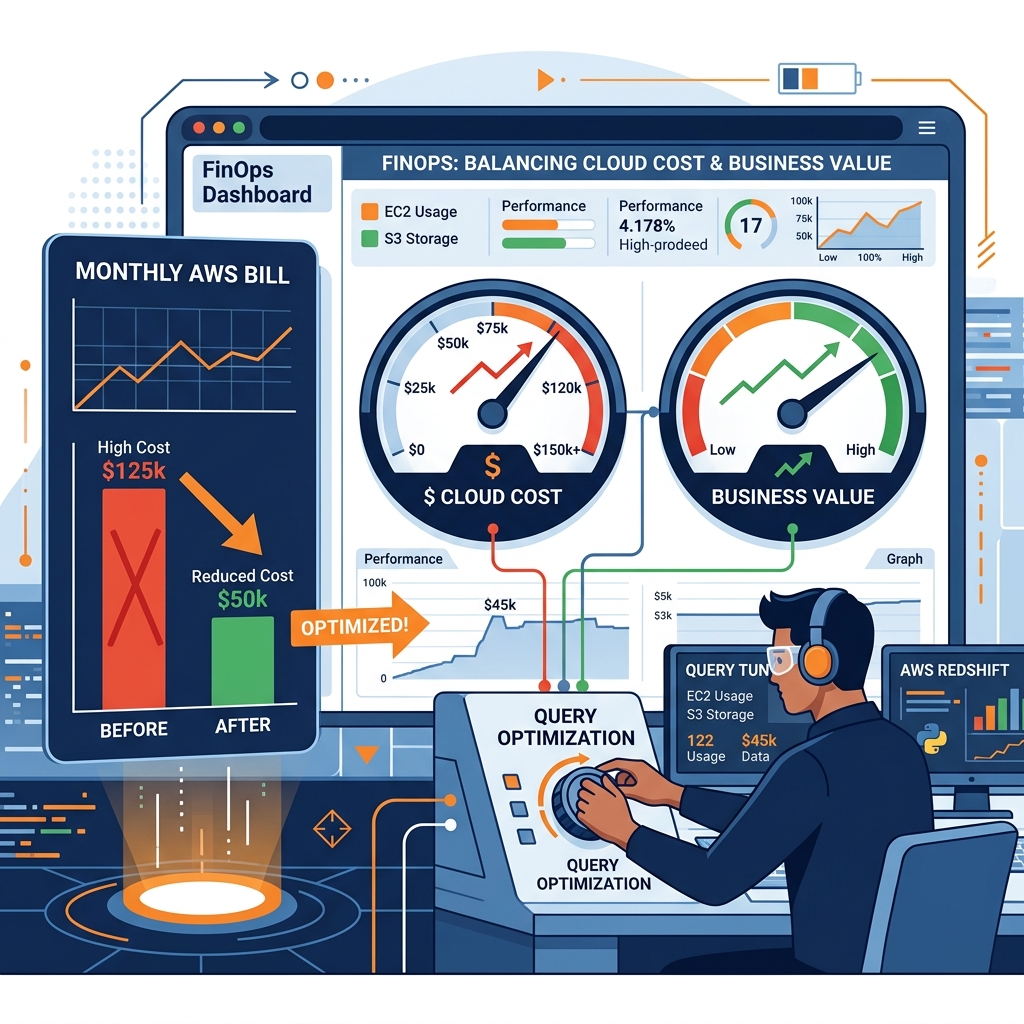
FinOps (Financial Operations) is the discipline that emerged to solve this cloud paradox. It is the practice of bringing financial accountability and visibility directly into the engineering workflow, ensuring that the business gets maximum value out of every cloud dollar spent.
The Core Principles of FinOps
FinOps is not about simply cutting costs; it is about maximizing business value. If spending an extra $10,000 on Snowflake compute allows the marketing team to generate $500,000 in new sales, FinOps encourages that spend.
1. Visibility and Allocation: The foundation of FinOps is tagging. Every cloud resource (every S3 bucket, every Dremio engine, every Airflow DAG) must be tagged with metadata indicating which specific team or project owns it. When the monthly AWS bill arrives, the FinOps team can clearly attribute costs: “Marketing spent $15k, HR spent $2k.”
2. Optimization: This is where data engineering intersects directly with finance. Engineers must actively optimize their architectures for cost. This includes writing more efficient SQL, using cheaper hardware (like Graviton processors), aggressively utilizing Time-to-Live (TTL) to delete useless data, and moving cold data to Glacier archiving tiers.
3. Purchasing Strategy: While engineers optimize the code, the FinOps team optimizes the buying strategy, negotiating massive “Committed Use Discounts” (Reserved Instances) with the cloud providers, committing to a baseline level of spend in exchange for 40-60% discounts on the compute rate.
FinOps in the Lakehouse
Modern Data Lakehouses (like Dremio or Databricks) are uniquely positioned for FinOps due to the separation of storage and compute.
Because compute engines can be spun up and down instantly, engineers can implement aggressive Auto-Suspend policies (shutting the cluster down if no queries arrive for 5 minutes). Furthermore, by routing non-critical, background ETL batch jobs to “Spot Instances” (excess cloud capacity sold at a 90% discount, but which can be terminated by AWS at any moment), data teams can process massive pipelines for pennies on the dollar, achieving peak FinOps efficiency.
Learn More
The books by Alex Merced go further on this topic and the systems it sits inside. Short video explainers cover the same ground in under a minute each.