Property Graphs
The property graph is the data model used by graph databases to represent complex, highly connected networks of nodes and relationships, where both can contain rich metadata properties.
By Alex Merced Last updated
Modeling the Connections
Relational databases (like PostgreSQL) are exceptional at storing highly structured, tabular data. However, they struggle immensely when tasked with querying deep, complex relationships.
If you want to find “the friends of the friends of the friends of User A who also bought Product B,” a relational database requires a series of massive JOIN operations across massive tables. As the network depth increases (from friends, to friends-of-friends, to third-degree connections), the SQL query becomes an unreadable nightmare, and the performance degrades exponentially.
Property graphs are a specific data model designed to solve this problem. Used by Graph Databases (like Neo4j), property graphs treat the relationships between data as equally important as the data itself.
The Anatomy of a Property Graph
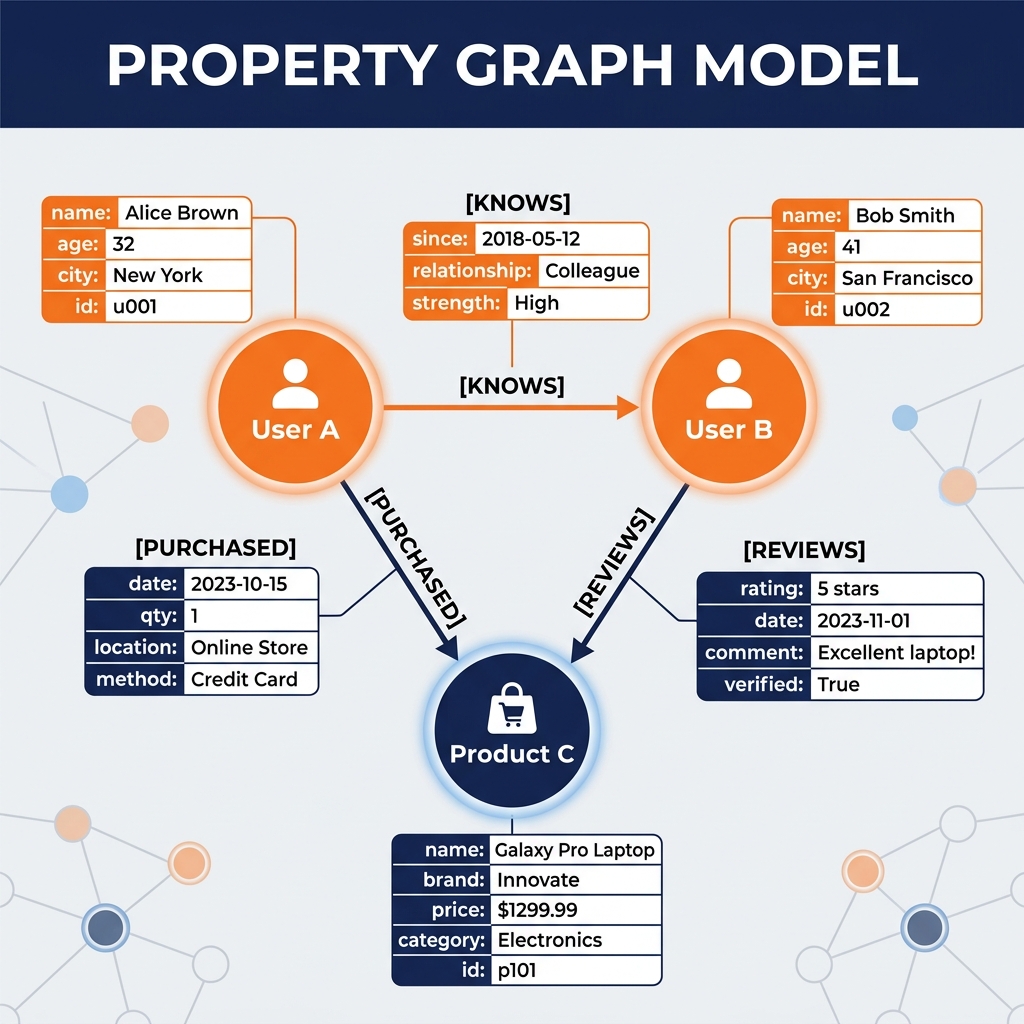
A Property Graph consists of three core components:
1. Nodes (Vertices): The entities in your data. A node might represent a Person, a Product, or a Company.
2. Edges (Relationships): The lines connecting the nodes. An edge is directional and has a type (e.g., Person A [KNOWS] Person B, or Person A [PURCHASED] Product B).
3. Properties: The key-value pairs of metadata attached to both nodes and edges. A Person node might have properties like {name: "Alice", age: 30}. Crucially, the [KNOWS] edge can also have properties, like {since: 2015, trust_level: "High"}.
Index-Free Adjacency
The performance secret of a property graph database is “Index-Free Adjacency.” In a relational database, finding a connection requires scanning an index to match Foreign Keys.
In a native graph database, every node physically stores physical memory pointers to its adjacent connected nodes. Traversing the graph (moving from “User A” to their “Friends”) is not a search operation; it is simply following a direct memory pointer. This allows graph databases to traverse millions of relationships per second, regardless of the total size of the dataset.
Use Cases for Property Graphs
Fraud Detection: Fraud rings often involve complex networks of synthetic identities sharing the same IP addresses, phone numbers, or credit cards. A property graph can instantly detect a circular ring of money transfers (A pays B, B pays C, C pays A) that would be nearly impossible to spot in a tabular database.
Recommendation Engines: E-commerce platforms use property graphs to power real-time recommendations by quickly traversing the graph: “Find all users who [PURCHASED] the same items as the current user, then traverse out to find other highly-rated items those similar users also [PURCHASED].”
Learn More
Several of the books by Alex Merced cover this in depth, and a few of them are free. The rest of the knowledge base is worth a look too.